Can a camera find every sewer leak?
No. A camera shows visible internal conditions. Other tests may be needed when the question is leakage rather than a visible obstruction or break.
Livonia, Michigan · Drain and sewer services
See the accessible pipe and record what the footage supports.
Looking for sewer camera inspection in Livonia? A sewer camera can help identify roots, deposits, joint displacement and other visible defects. We discuss access, line length and the purpose of the inspection before choosing the equipment and route.
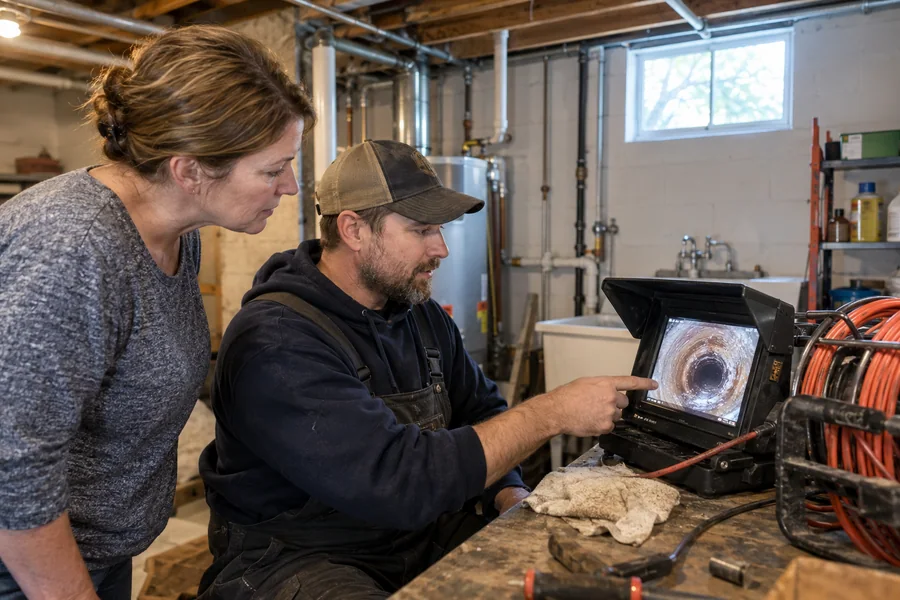
A private lead investigation may need to reach the connection.
Livonia states that the individual sewer lead and its connection to the main are the homeowner’s responsibility. That makes the inspected route and the recorded end point useful parts of a private sewer assessment.
For an occupied basement, describe the stair width, stored items and floor finishes before the visit. A clear route protects belongings and lets the technician position equipment near appropriate access. Report possible public-main symptoms to the city as well.
A recurring blockage needs more than a guess about where roots might be. Useful footage shows the inspected section, visible condition and any limits on visibility. Water, debris and inaccessible bends can prevent a complete view, and those limits should be explained.
A camera records what is visible inside the accessible pipe. It does not guarantee detection of every leak or establish the condition of inaccessible sections. Locating depends on the equipment and site conditions.
The access point, intended distance and need for locating affect the inspection quote. A blocked line may need separate cleaning before useful footage can be obtained. Ask what record of the findings is included.
Keep the recording and written observations together. Before approving a repair, ask which visible defect supports it, where it sits and whether the proposed method can address that condition.
Local utility guidance for Livonia
A private lead investigation may need to reach the connection. For an occupied basement, describe the stair width, stored items and floor finishes before the visit. A clear route protects belongings and lets the technician position equipment near appropriate access. Report possible public-main symptoms to the city as well.
No. A camera shows visible internal conditions. Other tests may be needed when the question is leakage rather than a visible obstruction or break.
Camera access through an existing suitable cleanout usually avoids excavation. A missing or inaccessible opening can change the access plan.
It can help document the accessible sewer condition. Confirm the intended distance, recording and inspection limitations before booking.
Ask which access point was used, how far the inspection reached and whether the connection was visible. Keep the observations with earlier cleaning or repair records.
A slow sink and a basement backup need different investigations.
A blockage can hide a leaking trap, damaged fitting or poorly supported drain.
Call when wastewater is rising, a toilet is overflowing or several fixtures have stopped draining.
Hydro jetting can remove deposits that leave a line restricted after basic clearing.
When several fixtures drain badly together, the shared main deserves attention.
A private sewer carries wastewater from the building toward the public collection system.
A sewer backup creates two jobs: address the drainage fault and manage the affected building materials.
A broken joint, damaged fitting or collapsed section needs a repair plan supported by the findings.
Trenchless methods can reduce surface disturbance on a suitable sewer.
Call with the address, affected fixtures and any previous inspection details. The phone line is available 24/7; confirm the current service window and proposed scope on the call.